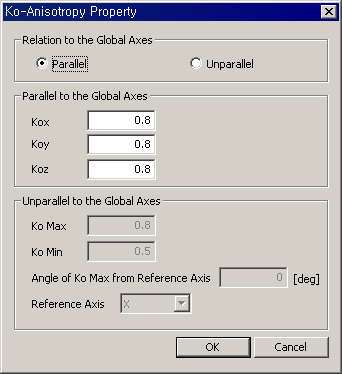
<Ko-Anisotropy Property dialog box>
Relation to the Global Axes
Parallel
Unparallel
Parallel to the Global Axis
Kox
Koy
Koz
Unparallel to the Global Axis
Ko Max
Ko Min
Angle of Ko Max from Reference Axis
Reference Axis
Property: Material |
|
||
|---|---|---|---|
|
|
|
|
Function |
Define the material properties of structures and ground. |
||
|
|
|
|
Call |
Model > Property > Material
|
||
|
|
|
|
For
new or additional Material, click
<Material>
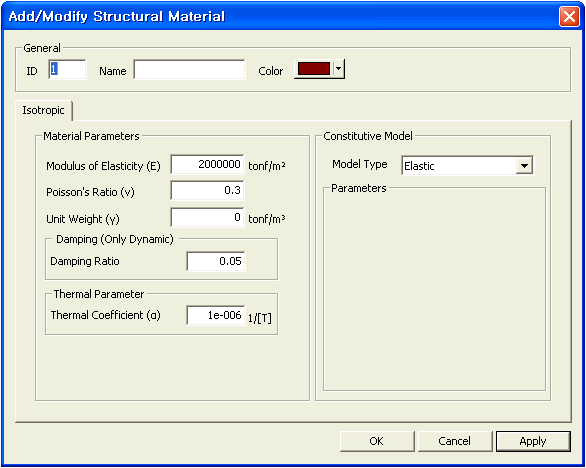
<Add/Modify Structural Material>
General ID Material
property number. Material
property name. Select
the color of Material property. Material Parameter Modulus of Elasticity Enter
the elastic modulus of material. Enter
the poisson's ratio of material. Enter the unit Weight of material Damping(Only Dynamic) Damping Ratio Enter the damping ratio of structural material. (Damping ratio is only reflected in case
of Analysis Type : Time History(Linear)).
The
dialog boxes, where material properties are defined by the user,
used to be activated with default values. GTS automatically
inactivates unnecessary parameters of each material model for
analysis. For example, properties in the elastic model, such as
cohesion and internal friction angle, which are not used for calculation,
are inactivated.
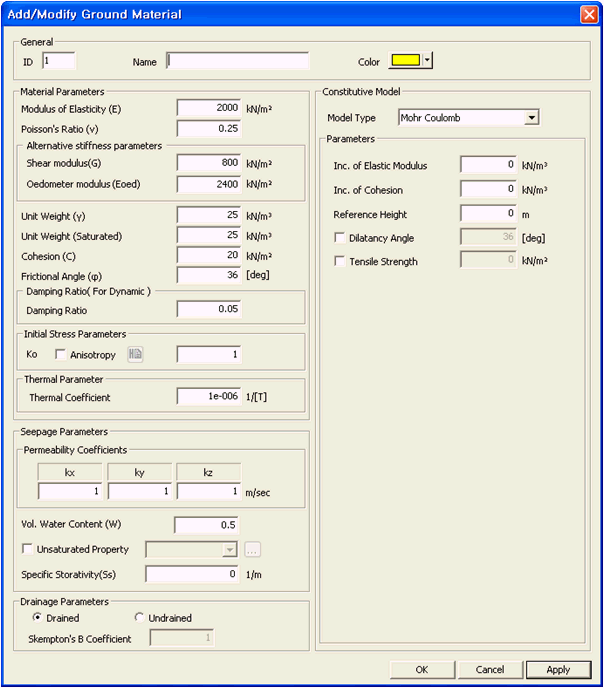
<Add/Modify Ground Material>
General ID Material
property number. Material
property name. Select
the color of Material property. Material Parameter Modulus of Elasticity Enter
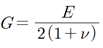
the Modulus of Elasticity. Poisson's ratio is used to calculate the Shear Modulus of Elasticity
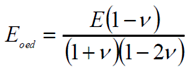
Alternative Stiffness Parameters Instead of using the Young’s modulus as a stiffness parameter, alternative stiffness parameters of G and Eoed can be entered. The alternatives are influenced by the input values of E and ν. (These parameters are available in Elastic, Tresca, von Mises, Drucker Prager, Mohr Coulomb, Hoek-Brown, Hyperbolic, Strain Softening, Modified Cam Clay, User supplied material) Shear Modulus(G) Enter the Shear Modulus. where Oedometer Modulus(Eoed) Enter the Oedometer Modulus. where
Unit Weight Enter
the unit weight of ground material. Enter
the unit weight of ground material after saturation. Enter
the cohesion parameter. Enter the frictional angle of ground material
Damping(Only Dynamic) Damping Ratio Enter the damping ratio of ground material. (Damping
ratio is only reflected in case of Analysis Type : Time History(Linear))
. Initial Stress Parameter If Anisotropy is not checked Ko : Coefficient
of Earth Pressure at Rest Seepage Parameter Permeability Coefficient Enter
Permeability Coefficient in each direction. Enter the volumetric water content. Unsaturated Property This
option defines permeability function and water content function
which are used in the unsaturated seepage analysis. If no function
has been defined, click Drainage Parameter
Drained Check
on to consider drained condition. Check
on to consider undrained condition. Note: In order to fully activate an undrained condition, this option must also be activated in "Define Construction stage." Refer to Define Construction Stage.
Skempton's B Coefficient Input parameter for Skempton's B Coefficient. Constitutive Model Select
ground material model. MIDAS/GTS provides the following 13 material
models. Please refer to Analysis Manual for detail information. To modify previously entered Material data,
select the Material to be modified in the list of the Material
dialog box and click To remove previously entered Material data,
select the Material to be deleted in the list of the Material
dialog box and click To copy previously entered Material data,
select the Material to be copied in the list of the Material dialog
box and click To import previously entered Material data
from another GTB file, click
<Import Material>
Material List Display Material data contained in the
existing *.GTB file. Selected List Select Material data to be imported and
register the data in the Selected List. Numbering Type of Material Specify the Import mode for material property numbers. Keep ID Import
the data keeping the same material property numbers. Assign new numbers to the imported material property data. To modify
previously entered material property numbers, Select Material
numbers to be renumbered from the list in the Material dialog
box and modify the related data followed by clicking
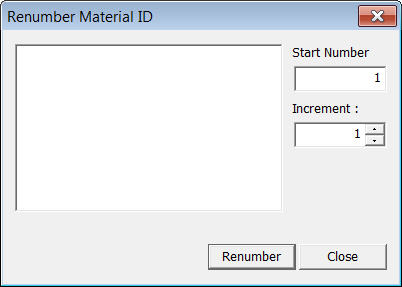
<Renumbering Material>
Start number Assign a new starting number for Material
to be modified. Increment number Enter the increment for numbering Material
numbers. Change element's material number Modify a material property number. Using this option will modify the previously defined material property number. If this option is not checked, the selected material having previously defined number will become undefined and the additional user-defined material number will be created without any assigned elements. |
|||
|
|
|
|


 in the Properties
dialog box and select Structure for structural material or Ground
for ground material.
in the Properties
dialog box and select Structure for structural material or Ground
for ground material.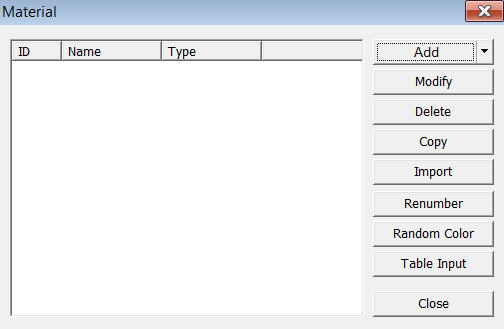
.jpg) button
to add a new unsaturated property function.
button
to add a new unsaturated property function..jpg) to modify
the related data.
to modify
the related data..jpg) .
. .
..jpg) and select the GTB file containing Material data or specify a
file name and then click Open button.
and select the GTB file containing Material data or specify a
file name and then click Open button.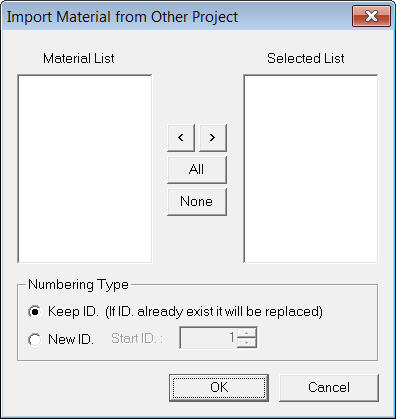
 .
.