 Revision of Ver.7.4.1
 Revision of Ver.7.4.1
Function
Define the tendon properties such as tendon area and instantaneous prestress losses.
Call
From the Main Menu select Load > Prestress Loads > Tendon Property.
Select Static Loads > Prestress Loads > Tendon Property in the Menu tab of the Tree Menu.
Entry
.jpg)
 To define
new or additional tendon properties
To define
new or additional tendon properties
Click .jpg) in the Tendon Property
dialog box and enter the following:
in the Tendon Property
dialog box and enter the following:
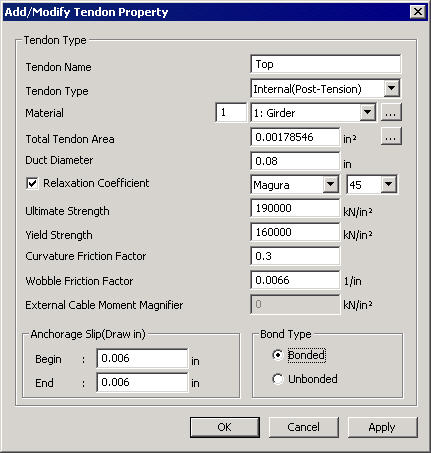
Add/Modify Tendon Property dialog box
 Tendon Name:
tendon name being defined Tendon Type
Tendon Name:
tendon name being defined Tendon TypeDefine the tendon type among Pre-Tension, Post-Tension and External.
Internal (Pre-Tension): Prestressing tendons prior to casting concrete, which transmits prestress through bonding between concrete and tendons
Internal (Post-Tension): Post-tensioning tendons through hardened concrete members ?tendons are gradually stressed and anchored to the members.
External: Tendons are placed external to concrete members and stressed.
Note
1
Depending on the Tendon Type (Pre-Tension, Post-Tension and External),
the entry fields for variables related to tension losses in tendons and
duct diameter are either activated or inactivated.
.jpg) Display.
Display.
MaterialSelect the material properties of the tendon.
Click  to the right to add new or modify/delete previously
defined tendon properties.
to the right to add new or modify/delete previously
defined tendon properties.
Total Tendon AreaSpecify the total area of the tendon. You
may either directly specify the cross-sectional area or click to enter the standard cross-sectional area and the number
of strands for auto-calculation of the total area.
|
|
Tendon Type |
|||||
|
12. 4 |
12. 7B |
15. 2B |
G15. 2 |
28. 6 | ||
|
Number of Strands |
EA |
12 |
12 |
12 |
19 |
1 |
|
Tendon Area |
CM2 |
11.148 |
11.8452 |
16.644 |
26.353 |
5.324 |
|
Duct Diameter |
CM |
6.8 |
6.8 |
7.8 |
11.5 |
5 |
|
Wobble Friction Factor λ |
/m |
0.004 |
0.004 |
0.004 |
0 |
0.004 |
|
Curvature Friction Factor μ |
/rad |
0.3 |
0.3 |
0.3 |
0.3 |
0.3 |
|
Anchorage Slip |
mm |
11 |
12 |
11 |
5 |
5 |
|
Relaxation |
% |
5 |
5 |
5 |
1.5 |
2.5 |
|
Young's Modulus |
N/mm2 |
200000 |
200000 |
200000 |
200000 |
200000 |
|
Yield Strength σpy |
N/mm2 |
1450 |
1600 |
1600 |
1600 |
1500 |
|
Tensile Strength σpu |
N/mm2 |
1700 |
1850 |
1850 |
1860 |
1800 |
Duct Diameter
Strand Diameter Revision of Ver.7.4.1 Relaxation Coefficient: C
Select Magura or CEB-FIP for the method of applying relaxation. To ignore the steel relaxation, uncheck the box.
Select 10 or 45 for Relaxation Coefficient (C), which relates to the product. Relaxation coefficients of 10 and 45 may be used for general steel and low-relaxation steel respectively. Losses due to steel relaxation are determined from the following equation:
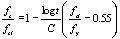
where,  ,
, : initial stress,
 : stress
at time t after loading,
: stress
at time t after loading,  : yield stress (0.1% Offset Yield
Stress)C: Relaxation Coefficient (general steel: 10, low-relaxation steel:
45)
: yield stress (0.1% Offset Yield
Stress)C: Relaxation Coefficient (general steel: 10, low-relaxation steel:
45)
Enter the final loss ratio due to steel relaxation. Prestress loss due to steel relaxation is determined from the following equation:
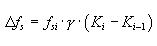
where,: initial stress,
 : final loss ratio due to steel relaxation,
  : progress of steel relaxation at the last time step
The progress of steel relaxation with time is as follows:
|
Progress of relaxation (k) |
Lapse |
|
k=1/16 ln{ (t-to)/10+1 } |
0 ≤ (t-to) ≤ 1000 |
|
k={ (t-to)/(0.5?0^6) }0.2 |
1000 ≤ (t-to) ≤ 0.5x10⁶ |
|
k=1. 00 |
(t-to) ≥ 0.5 x10⁶ |
where to: the timing of prestressing, t: the time when tendon loss due to relaxation is evaluated
Revision of Ver.7.4.1Note
For Relaxation Coefficient (C), 10 for general steel and 45 for low-relaxation steel may be entered. Check off the box to ignore Relaxation.
.jpg)
If the user selects JTG04 standard in the Material Data and selects JTG04 for Relaxation Coefficient in the Tendon Property, the Characteristic Value of Strength (fpk) is automatically entered as per the JTG04 code. If the user does not select JTG04 standard in the Material Data, the user can directly enter the Characteristic Value of Strength (fpk).
In case Steelbar540, Steelbar785 or Steelbar930 is selected in the Material Data, the Application of Overstress Reduction Factor is ignored.
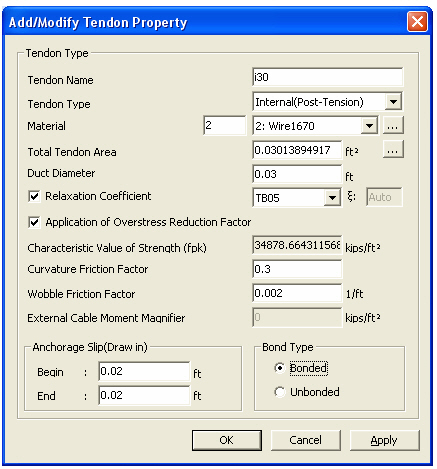
If the user selects TB05 standard in the Material Data and selects TB05 for Relaxation Coefficient in the Tendon Property, the Characteristic Value of Strength (fpk) and the Tendon Relaxation Coefficient (ξ) are automatically entered as per the TB05 code. If the user does not select TB05 standard in the Material Data, the user can directly enter the Characteristic Value of Strength (fpk) directly.
Note
Calculation of Tendon Relaxation Coefficient (ξ) and loss due to Relaxation Tendon Relaxation
Curvature Friction FactorCalculation
of Relaxation Coefficient ( )
)
If material = Wire1470, Wire1570, Wire1670, Wire1770, Wire1860
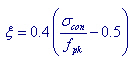
If material = Strand1470, Strand1570, Strand1670, Strand1720, Strand1770, Strand1820, Strand1860
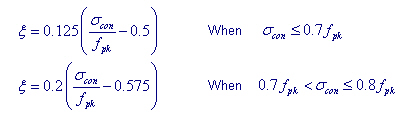
If material = PSB830

If material = PSB830 and Application of Overstress Reduction Factor is checked on

Calculation of Prestress Loss
If  is
greater than or equal to
is
greater than or equal to 

If
is
less than

where , :
The loss of Prestressed Stress due to Tendon Relaxation
 :
Tendon Relaxation Coefficient
:
Tendon Relaxation Coefficient
 :
Anchor Tendon Stress
:
Anchor Tendon Stress
 :
Tendon Tension Strength Standard Value
:
Tendon Tension Strength Standard Value
to account for friction loss due to the curvature of tendons
Wobble Friction FactorTo account for straightness/length effect (imperfection in alignment along the length of tendon, regardless of straight or draped alignment)
Ultimate Strength
Yield Strength
External Cable Moment MagnifierEnter the increase of effective prestress of external cable to be used for calculating failure-resisting moment. Entered stress increase will be used for PC design.
Anchorage Slip (Draw in)Tendon slippage at the anchor
Begin: slippage at the beginning of tendon if tensioned here
End: slippage at the end of tendon if tensioned here
Bond
Type
Bonded: Section properties reflect the duct area after grouting
Unbonded: Section properties exclude the duct area.
To modify
the previously entered tendon data
Select the tendon from the list in the Tendon
Property dialog box and click .jpg) to change any relevant data.
to change any relevant data.
To delete
the previously entered tendon data
Select the tendon from the list in the Tendon
Property dialog box and click .jpg) to eliminate any relevant
data.
to eliminate any relevant
data.