Revision
of Ver.7.4.1
Revision
of Ver.7.4.1 Revision
of Ver.7.4.1
Displacement Contour
Function
Evaluate the displacements of a model by Displacement Contours.
Call
From the Main Menu select Results > Deformations > Displacement Contour.
Select Results > Deformations > Displacement Contour in the Menu tab of the Tree Menu.
Click .jpg) Displacement Contour in the
Icon Menu.
Displacement Contour in the
Icon Menu.
Usage
 Load Cases/Combinations
Select a desired load case, load combination or envelope case.
Click  to the right to enter
new or modify existing load combinations. (Refer to "Load Cases
/ Combinations")
to the right to enter
new or modify existing load combinations. (Refer to "Load Cases
/ Combinations")
Step
Specify the step for which the analysis results are to be produced. The
Step is defined in geometric nonlinear analysis as Load Step, and additional
steps are defined in the construction stages of highrise buildings or
heat of hydration analyses.
Note
The Construction Stage applicable for the output of the construction stage
analysis is defined in Select
Construction Stage for Display or Stage Toolbar.
Displacement
Display the displacement of the model in contour.
Velocity
Display the velocity in contour.
Acceleration
Display the acceleration in contour.
Absolute Acceleration
Display the absolute acceleration in contour.
Note1.
Difference between '(Relative) Acceleration' and 'Absolute Acceleration'
Acceleration (Relative) = Acceleration (Absolute) + Observer뭩 Acceleration
As seen from the above expression, Relative and Absolute accelerations
differ depending on the presence of Observer뭩 acceleration.
Note2.
Above items become activated only when time history analysis has been performed.
|
|
Select the desired displacement component among the following: DX: Displacement component in GCS X-direction DY: Displacement component in GCS Y-direction DZ: Displacement component in GCS Z-direction RX: Rotation component about GCS X-axis RY: Rotation component about GCS Y-axis RZ: Rotation component about GCS Z-axis DXY
= DYZ
= DXZ
= DXYZ
= |
Type of Display
Define the type of display as follows:
|
Contour |
Display the displacement of the model in contour.
|
|
|
Ranges: Define the contour ranges.
Note Number of
Colors: Assign the number of colors to be included in the contour
(select among 6, 12, 18, 24 colors) Colors: Assign or control the colors of the displacement contour. Color Table: Assign the type of Colors.
Reverse Contour: Check on to reverse the sequence of color variation in the contour. Contour Line: Assign the boundary line color of the contour Element
Edge: Assign the color of element edges while displaying the contour Contour Options: Specify options for contour representation Contour Fill Gradient
Fill: Display color gradient (shading) in the contour. Draw Contour
Line Only Mono line: Display the boundaries of the contour in a mono color. Contour
Annotation Spacing: Display the spacing for the legnd or annotation. Coarse Contour
(faster) (for large plate or solid
model) Extrude
|
|
Deform |
Display the deformed shape of the model.
|
|
|
Deformation
Scale Factor Deformation
Type Nodal Deform:
Display the deformed shape reflecting only the nodal displacements. Real Displacement (Auto-Scale off): The true deformation of the structure is graphically represented without magnifying or reducing it. This option is typically used for geometric nonlinear analysis reflecting large displacement. Relative Displacement: The deformation of the structure is graphically represented relative to the minimum nodal displacement, which is set to 0.
|
|
Values |
Display the
nodal displacements in numerical values.
|
|
|
Decimal
Points: Assign decimal points for the displayed numbers Min
& Max: Display the maximum and minimum values Set Orientation: Display orientation of numerical values Note
|
|
Legend |
Display various references related to analysis results to the right or left of the working window.
|
|
|
Legend Position: Position of the legend in the display window Rank Value Type: Specify a type of values in the Legend and the number of decimal points. |
|
Animate |
Dynamically simulate the transition process. Click
|
|
|
Animation Mode: Determine the type of animation for analysis results. Animate
Contour: Option to change the color of the contour representing
the transition according to the magnitudes of variation Note AVI Options: Enter the options required to produce the animation window. Bits per
Pixel: Number of bits per pixel to create the default window for
animation Construction Stage Option: Select the animation options when the construction stage analysis is performed. Stage Animation:
Animations by construction stages |
|
Undeformed |
Overlap the undeformed and deformed shapes of the model.
|
|
Mirrored |
"Mirrored" allows the user to expand the analysis results obtained from a half or quarter model into the results for the full model by reflecting planes.
|
|
|
Half
Model Mirroring
|
|
Plate Cutting Diagram |
Displacement of plate elements is produced in a graph along a specific line or plane cut through the elements. The following dialog box is used to specify the conditions required to generate the displacement diagram along the cutting line/plane.
|
|
|
Click
|
.jpg)
.jpg)
Plate Cutting Diagram Dialog Box
Plate Cutting Diagram Mode
Cutting Line: Produce a graph along a cutting line
Cutting Plane: Produce a graph along the line of intersection of the cutting plane and plate elements
 When Cutting Line is selected
Define Cutting Lines
List of defined Cutting Lines
.jpg) : Add the information
contained in the Cutting Line Detail to the list of Defined Cutting Lines
: Add the information
contained in the Cutting Line Detail to the list of Defined Cutting Lines
.jpg) : Delete a defined cutting
line
: Delete a defined cutting
line
.jpg) : Modify a defined cutting
line
: Modify a defined cutting
line
Cutting Line Detail
Define a Cutting Line
Name: Name of a Cutting Line
Pnt1: Start point of the Cutting Line
Pnt2: End point of the Cutting Line
Options
Specify the display color and the plane on which the graph is produced
Normal: Display the graph in the Normal direction of plate elements
In Plane:
Display the graph in the In-Plane direction of plate elements
Scale
factor: Scale factor for diagram output ratio
Reverse: Express the Diagram in the reverse direction.
|
Graph |
Produce the output in a Graph Window ( valid only if 'Cutting lines' is selected).
|
|
|
Access the Plate Cutting Diagram Mode Dialog Box to determine the type of Graph Window. Draw graphs on separate panes: Graphs pertaining to different Cutting Lines/Planes produced separately Draw graphs on All in one pane: All the graphs pertaining to different Cutting Lines/Planes simultaneously produced in one graph X-axis: Define the X-axis of the graph Distance from Pnt1: Distance from the first point Global X coord. Global Y coord. Global Z coord. |
Value Output: Produce the output in values.
MinMax Only: Show only the maximum and minimum values when Value Output is selected.
When Cutting Plane is selected
Named Planes for Cutting
Select a plane from the defined planes and UCS x-y, x-z & y-z planes
Plate Cutting Plane Detail
Normal to plate: Consider a Cutting Plane parrallel to the Local Element Coordinate System z-axis of the plate elements
On cutting plane surface: Consider a Cutting Plane as per a defined plane
Draw continuous lines: Display the graphs for plate elements placed on different planes in a continuous line.
Scale Factor: Scale factor for diagram output ratio
Reverse: Express the Diagram in the reverse direction.
Value Output: Produce Output in numerical values
MinMax Only: Upon selecting Value Output, display only the Maximum and Minimum values.
|
Current Step Disp. |
Produce the displacements pertaining to the selected step of the construction stage if a construction stage analysis has been performed. |
|
Hinge Status |
The status of hinges formed by Pushover analysis is produced. |
|
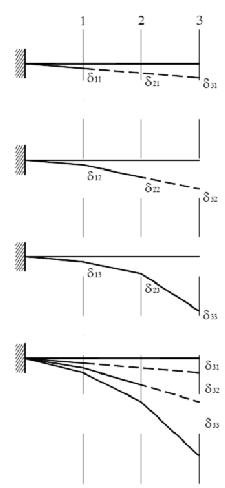
Stage/Step Real |
Display the Real Displacements for each construction stage when the construction stage analysis is performed.
Note Real displacement is relevant only for construction stage analysis. To illustrate real displacement, a cantilever is constructed in 3 stages as shown below. Node 3 is activated at the stage 3, and the deflection δ33 occurs due to the self weight of the segment 3. But when constructing steel girders or PC girders, the virtual displacements δ31 and δ32 occur at the stage 1 and stage 2 respectively. Real displacement is the summation of virtual displacements, which occur before the corresponding node is even activated and net displacement, which occurs after the node is activated. Real displacement corresponds to the fabrication camber.
|
Batch Output Generation (
.jpg) ,
, .jpg) )
)
Given the types of analysis results for Graphic outputs, generate consecutively graphic outputs for selected load cases and combinations. A total number of files equal to the products of the numbers of checked items in the three columns of the dialog box below are created.
|
|
Assign a Base
File Name under which the types of results (selection data in the Batch
Output Generation dialog box for graphic outputs) are stored. |
|
|
Specify the Base Files to perform Batch Output Generation, construction stages, load cases (combinations), steps, etc. in the following dialog box. |
.jpg)
Batch Output Generation Dialog Box
Saved Menu-Bar Info's: Listed here are the Base Files. Select the Base File Names for Batch Output.
.jpg) : Delete all the Base Files selected with the mouse.
: Delete all the Base Files selected with the mouse.
When the construction stage analysis is carried out, all the construction stages are listed. We simply select the stages of interests to be included in the batch output. If no construction stage analysis is performed, the column in the dialog box becomes inactive and lists load (combination) conditions.
Stages
The results output of all the construction stages are produced. The construction
stages are listed below.
Final Stage Loads
The results output for only the Final Stage are produced. The construction
stages are listed below. If no construction stage analysis is performed,
the load (combination) conditions are listed.
Use Saved
Apply only the (saved) step or load (combination) condition selected at
the time of creating each Base File.
Stage LCase/LComb
When the construction stage analysis is carried out, the auto-generated
construction stage load conditions and the additionally entered construction
stage load combinations are listed. Check on only the load (combination)
conditions that will be used to produce batch outputs. This column becomes
inactive if Final Stage Loads is selected or no construction stage analysis
is carried out.
Step Option
Specify the steps for which the outputs will be produced when the construction
stage analysis or large displacement geometric nonlinear analysis is performed.
Saved Step: Use only the steps used for creating the Base Files
All Steps: Use all the steps
Output Options
Output File Type
Select a Graphic File type, either BMP or EMF.
Auto Description:
At the top left of the Graphic Outputs produced in batch, auto-generate
and include the notes such as the types and components of the analysis
results, construction stages and steps, load (combination) conditions,
etc. The font size, color, type, etc. can be changed upon clicking the
button .
Output Path
Specify the path for saving the graphic files to be produced in batch.
File Prefix: Specify the prefix of the Graphic Files to be created. The filenames will be consisted of "Prefix"_"Base File Name"_"Load Comb.".bmp(emf) or "Prefix"_"Base File Name"_"Stage"_"Stage LCase"_"Step".bmp(emf).
.jpg) : Produce the specified batch
Graphic Files reflecting the contents of the dialog box.
: Produce the specified batch
Graphic Files reflecting the contents of the dialog box.
.jpg) /
/ .jpg)
Produce the contents of data input in the
Base Files and Batch Output Generation dialog box in a binary type file
(fn.bog). Click the button and select a fn.bog to use
the same output format.
Note
Import /Export is only meaningful for different projects. In a given structural
model, the Base Files are automatically stored and listed.
.jpg)
.jpg)
.jpg)
.jpg)
.jpg)
.jpg) : Assign the color distribution
range of contour. Using the function, specific colors for specific ranges
can be assigned.
: Assign the color distribution
range of contour. Using the function, specific colors for specific ranges
can be assigned..jpg) : Control the colors by zones
in the contour.
: Control the colors by zones
in the contour..jpg)
.jpg) then click
then click .jpg) Record to the right of the Animation
control board at the bottom of the working window.
Record to the right of the Animation
control board at the bottom of the working window..jpg) : Assign the method of compressing image data
: Assign the method of compressing image data