Elastic Ground (Equivalent Linear) | ||||||
|
| ||||||
|
| ||||||
|
The Elastic Ground (Equivalent Linear) model is used to model the behavior of soil under the action of dynamic loading. Soil behavior changes from linear to nonlinear as the induced shear strain increases from 10^-6 to 10^-3. The soil mass is modeled as a linear mass upto the strain level of 10^-3 and dynamic properties of soil, which are independent of the strain amplitude, are expressed in terms of a linear model. The following image shows the difference between Equivalent-Linear and Cyclic Nonlinear behavior.
Applicable Modules:
| ||||||
|
| ||||||
|
| ||||||
|
|


.gif)
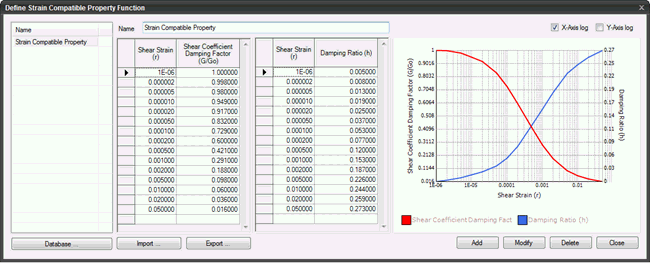
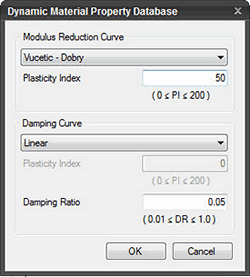
|
Classification |
Database |
|
Modulus Reduction Curve |
Clay - Pl=5-10 (Sun et al.0) Clay - Pl=10-20 (Sun et al.0) Clay - Pl=20-40 (Sun et al.0) Clay - Pl=40-80 (Sun et al.0) Clay - Pl=80+ (Sun et al.0) Clay (Seed and Sun 1989) Gravel (Seed et al.0) Linear Rock Rock (Idriss) Sand (Seed & Idriss) - Lower Bound Sand (Seed & Idriss) - Average Sand (Seed & Idriss) - Upper Bound Sand (Seed and Idriss 1970) Vucetic - Dobry |
|
Damping curve |
Clay - Lower Bound (Sun et al.0) Clay - Average (Sun et al.0) Clay - Upper Bound (Sun et al.0) Clay (Idriss 1990) Gravel (Seed et al.0) Linear Rock Rock (Idriss) Sand (Idriss 1990) Sand (Seed & Idriss) - Lower Bound Sand (Seed & Idriss) - Average Sand (Seed & Idriss) - Upper Bound Vucetic - Dobry |
Note: The user may also input the values to draw Modulus Reduction and Damping curves manually.
Import
Import a *.scp file.
Export
Export a *.scp file.
Log Axis
Specify log scale on X and Y axis.