The Sekiguchi-Ohta (Visco
Elasto-Plastic) model can be considered as a generalized Cam Clay model
type for the behavior of clay type soils. It is a viscid model for time
dependent behavior, utilizes effective stresses and has anisotropic hardening
feature. The model is reduced to original Cam Clay model under isotropic
stress conditions.
Applicable Modules:
Tunnel
Slope
Soft
Ground
Foundation
Seepage
Dynamic
General Parameters
Modulus
of Elasticity (E)
The slope of the stress-strain
line for a linear isotropic material.
Poisson's Ratio (u)
The ratio of the radial
(or lateral) strain to the vertical strain.
Temperature Coeff. (α)
The relative change
of a physical property when the temperature is changed by 1 K.
Unit Weight (Υt)
The weight of soil per unit volume.
Saturated Unit Weight
(Υsat)
The weight of saturated soil per unit volume.
Internal Friction Angle
(Φ)
It is a measure of the shear strength of
soils due to friction.
Earth
Pressure Coeff. (Ko)
The ratio of horizontal principal effective
stress to the vertical principal effective stress.
Hori. Permeability Coeff.
(Kh)
The coefficient of permeability in horizontal
direction.
Ver. Permeability Coeff.
(Kv)
The coefficient of permeability in vertical
direction.
Additional
Parameters
Additional Parameters Auto-Calculation
Choose
the calculation method
and input the parameters.
Calculation Method
Karibe
Equation
Plastic
Index (PI)
λ = 0.015 + 0.007 *
PI
Compression
index (Cc)
A user defined input
can be given and accordingly, λ is calculated as, λ = 0.434 * Cc
Empirical
Equation
Plasticity
index (PI)
λ = 0.015 + 0.007 *
PI
Compression
index (Cc)
λ = 0.434 * Cc
Expansion
index (Cr)
A user defined input
can be given and accordingly, K is calculated as, K = 0.434 * Cr
Plasticity
Index (PI)
The
range of water contents over which the soil deforms plastically is known
as the Plasticity Index.
Compression
Index (Cc)
It
is the slope of the Normal Consolidation Line in a plot of the log of
vertical effective stress vs. void ratio.
Recompression
Index (Cr) (only for Empirical Equation)
It
is the average slope of the unloading/reloading curves in a plot of the
log of vertical effective stress vs.
void ratio.
Drain
Distance (H)
Drain
Distance (H) remains constant and can be calculated from the expression
Over
Consolidation Ratio (OCR)
It
is the ratio by which the current vertical effective stress in the soil
was exceeded in the past.
Slope
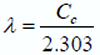
of N.C. Line (λ)
Slope
of the Normal Consolidation line. It is related to Compression index by
the relation
Slope
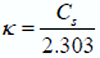
of O.C. Line (K)
Slope
of the Over Consolidation line. It is related to Compression index by
the relation
Expansion
Coefficient (D)
It
is the coefficient of Dilatancy. D can be estimated from the expression
Earth
Pressure Coeff. (Koc)
It
is the coefficient of earth pressure at preconsolidation.
Secondary
Consolidation Coeff. (α)
It
is the coefficient of secondary consolidation.
Initial
Volumetric Strain Rate (Vo)
It
is the volumetric strain rate at the start of secondary consolidation.
It is related to the Secondary Consolidation Coeff. (α) by the following
expression


.gif)