 Revision of Ver.7.4.1
 Revision of Ver.7.4.1
Function
Specify the iteration method and convergence conditions for performing a nonlinear analysis reflecting large displacement and material nonlinear analysis . The large displacement analysis can be applied to both general static analysis and construction stage analysis. Material nonlinear analysis can only be applied to static analysis. Prior to an analysis, specify the sequence of applying loads in Loading Sequence for Nonlinear Analysis, and define the convergence criteria for nonlinear analysis in Nonlinear Analysis Control. Specified loading sequence is effective only when Newton-Raphson is selected as the Iteration Method. Large displacement analysis and material nonlinear analysis can be performed on Truss, Plate, Plane Stress, Plane Strain, Axisymmetric, and Solid elements.
Note
Tension-only/Compression-only element will be changed to Truss element in Eigenvalue Analysis.
Call
From the Main Menu select Analysis > Nonlinear Analysis Control.
Entry

Nonlinear Analysis Control dialog box
 Nonlinear Type
Select a type of nonlinear analysis
Geometry Nonlinear: Geometric large displacement nonlinear analysis
Material Nonlinear: Material plasticity static analysis
Revision of Ver.7.4.1
Note 1
Following elements can be used in geometry nonlinear analysis and/or material nonlinear analysis
|
Element |
Geometry Nonlinear |
Geometry Nonlinear (Initial Force for Geometric Stiffness) |
Material Nonlinear |
|
Truss |
O |
O |
O |
|
Tension only |
O |
O |
O |
|
Hook |
O |
O |
O |
|
Cable |
O |
O |
Δ |
|
Compression only |
O |
O |
O |
|
Gap |
O |
O |
O |
|
Beam |
O |
O |
Δ |
|
Plate – Thick |
O |
Δ |
O |
|
Plate – Thin |
Δ(Considered as Thick Plate) |
Δ |
Δ (Considered as Thick Plate) |
|
Plane Stress |
O |
Δ |
O |
|
Plane Strain |
O |
Δ |
O |
|
Axisymmetry |
O |
Δ |
O |
|
Solid |
O |
Δ |
O |
(O : Analysis can be performed. / X : Analysis cannot be performed. / △ : Corresponding elements are considered as linear elements and then analysis can be performed.)
Note 2
Geometry nonlinear analysis and/or material nonlinear analysis cannot be performed for the items marked ×.
|
Limitation |
Geometry Nonlinear |
Material Nonlinear |
Material + Geometry Nonlinear |
Remark |
|
Beam End Release |
x |
O* |
x |
|
|
Plate End Release |
x |
O* |
x |
|
|
Pretension Load |
O |
x |
x |
|
|
Prestress Load |
O |
x |
x |
|
|
CInitial Forces for Geometric Stiffness |
O |
x |
x |
|
|
Temperature Loads |
O |
x |
x |
|
|
Material=SRC |
x |
x |
x |
|
In case of Beam End Release and Plate End Release, the material nonlinear analysis cannot be performed for the following case:
1) When Load > Nonlinear Analysis > Loading Sequence for Nonlinear Analysis is used
Note 3
Analysis result is produced only at both I & J ends of elements in geometry nonlinear analysis.
Iteration Method
Select the method of iteration.
If Newton-Raphson is selected
Number
of Load Steps
Divide the total load into the number of Load Steps and apply the loads
by each step.
Maximum
Number of Iterations/Load Step
Maximum number of iterations of analysis per Load Step.
If Arc-Length is selected
Number of Increment Steps
Maximum
Number of Iterations/Increment Step
Maximum number of iterations of analysis per Increment Step.
Maximum
Displacement Boundary
Magnitude of maximum displacement
Initial Force Ratio for Unit Arc-Length (%)
Ratio of the Initial Force per Unit Arc-Length
Note
Real number (decimal) can be input
If Displacement-Control is selected
Number of Displacement
Steps
Divide the total displacement into the number of Displacement Steps and
apply the incremental displacement by each step.
Maximum Number of Iterations/Increment
Step
Maximum number of iterations of analysis per Increment Step
Master Node
A reference node for displacement control
Direction
Direction of the displacement control
Maximum Displacement
The magnitude of maximum displacement to be applied to analysis
Convergence Criteria
Specify the basis on which to assess the convergence.
Energy
Norm
Assess the convergence on the basis of Energy (Member force x displacement)
Norm.
Displacement
Norm
Assess the convergence on the basis of Displacement.
Force Norm
Assess the convergence on the basis of Member Force Norm.
Note
The selection of the convergence criteria for repeating or ending the analysis
must be based on the condition to reflect the effects of various degrees
of freedom. For example, in the case of Displacement Norm, if the displacement
resulting from the corresponding analysis step is {D1}, and the total
displacement accumulated from each step is {D2}, the Norm is expressed
as .jpg) . If this value is smaller than the specified value, a
convergence is considered to have occurred and the program stops the iterative
analysis.
. If this value is smaller than the specified value, a
convergence is considered to have occurred and the program stops the iterative
analysis.
.jpg) : Remove the conditions for
a nonlinear analysis.
: Remove the conditions for
a nonlinear analysis.
Load Case Specific Nonlinear
Analysis Control Data
The above defined Iteration Method is applied individually by load cases. If the same iteration method is applied to all the load cases, this dialog box need not be used.
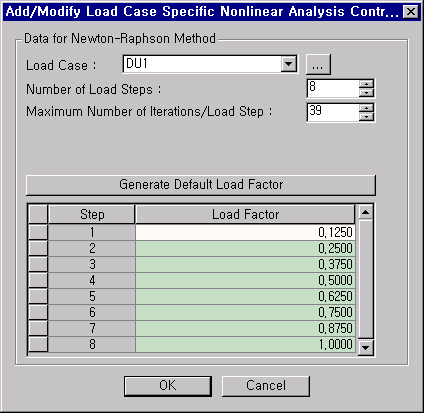
Load Case Specific Nonlinear Analysis Control Data dialog box
Data for Newton-Raphson/Arch-Length/Displacement-Control
Method
Title of Iteration Method specified
Step: Number of Load Steps entered
Load Factor: load factors for each increment, which can be user-defined or auto-generated by clicking on the Generation button.
8 steps are generated in the Dialog box above in accordance with the Number of Load Steps entered.
Load Factors can be
user-difined, or auto-generated by clicking on the button.
Note
When Arc-Length Method (ALM) is used to solve the nonlinear equilibrium equation, a real number can be inputted into the “Initial Force Ratio for Unit Arc-Length (%)” text box in Nonlinear Analysis Control.