Specify a plastic material model for material nonlinear analysis.
Plastic
Material Models
Tresca &
Von Mises
Appropriate for ductile metals, which exhibit
Plastic Incompressibility
Mohr-Coulomb,
Drucker-Prager
Appropriate for brittle materials such as
concrete, rock and soils, which exhibit the behavior of volumetric plastic
straining
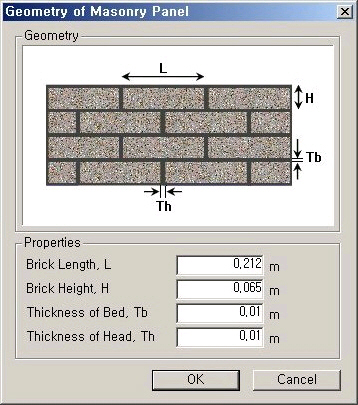
Masonry
Appropriate for the elastic analysis finding
the crack positions using masonry walls (solid elements).
Revision of Gen 2010
Note
Masonry material model is applicable to plate, 4-node solid, 6-node solid,
and 8-node solid elements.
From the Main Menu
select Model > Properties
> Plastic Material.
Select Geometry >
Properties > Plastic Material in the Menu
tab of the Tree
Menu.
Plastic
Material dialog box
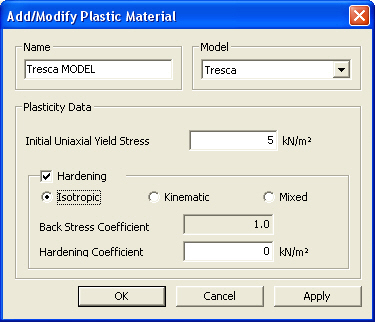
Add/Modify
Plastic Material dialog box
For new
or additional material properties
Click in the Plastic Material
dialog box and enter the following data:
Name: Name
of plastic model
Model: Type
of plastic model
Tresca:
This yield criterion is suitable for ductile materials such as metals,
which exhibit Plastic Incompressibility.
Von Mises:This yield criterion is based on
distortional strain energy and is the most widely used yield criterion
for metallic materials.
Mohr-Coulomb:This
yield criterion is a generalization of the Coulomb's friction rule and
is suitable for materials such as concrete, rock and soils,
which exhibit volumetric plastic deformations.
Drucker-Prager:This
criterion is a smooth approximation of the Mohr- Coulomb criterion and
is an expansion of the von Mises criterion. This Drucker-Prager criterion
is suitable for materials such as concrete, rock and soils, which exhibit
volumetric plastic deformations.
Orthotropic
material properties are assumed for modeling a masonry structure. So it
is important to define the Material Coordinate System properly.
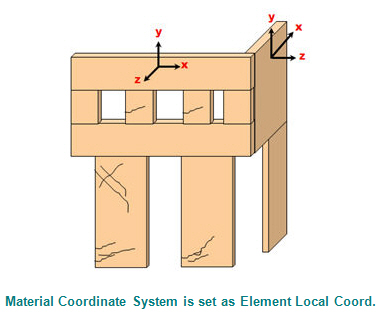
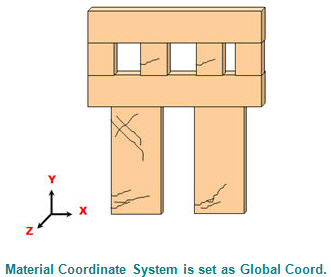
When Global
Coord is selected for the Material Coordinate System, the Global
Y axis corresponds to the gravitational direction of the model, and the
Global X axis corresponds to the horizontal direction of the model. However,
if the Element Local Coord is
selected as the Material Coordinate System, the local y axis of the element
should correspond to the gravitational direction of the model, and the
local x axis of the element should correspond to the horizontal direction
of the model.
Therefore, for masonry models where the
local axes of elements are not oriented in the same direction, it is better
to select Global Coord as the
material coordinate system and model the masonry structure on the global
X-Y plane. When the masonry model is not on the global X-Y plane, select
Element Local Coord as the Material
Coordinate System and set the local y axis of the elements in the gravitational
direction.
Plastic Data
If Tresca
or Von Mises is selected, specify
Initial Uniaxial (tensile) Yield Stress.
If Mohr-Coulomb
or Drucker-Prager is selected,
specify Initial Cohesionand Initial Friction Angle.
Initial Cohesion
Note
When normal stress is '0',
Initial Cohesion is equal to the yield stress due to shear stress only.
Initial Friction Angle
Note
Initial Friction Angle,
which is available only if Mohr-Coulomb or Drucker-Prager is selected
as the Plastic Material Model, ranges from 0 to 90. Either use the default
angle of 30 or specify the angle.
Hardening
As a material yields, hardening defines the change of yield surface with
plastic straining, which is classified into the following three types.
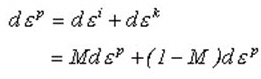
Total increment of Plastic
Hardening can be expressed by Isotropic Hardening and Kinematic Hardening
as follows:
In this case, M refers to
the Back Stress Coefficient, and ranges between 0 and 1.
Hardening Coefficient
Tangent stiffness of material after yielding
In general, after the first yielding, the
Hardening Coefficient either becomes smaller than the initial tangent
stiffness or becomes constant.
Note
In case of
von Mises model (Plastic Material), the Hardening Coefficient cannot exceed
the Elastic Modulus defined in Model > Property >Material.
When Masonry is selected
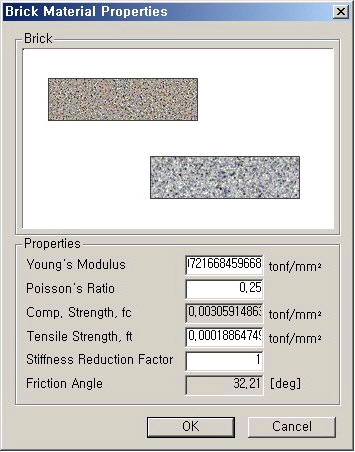
Brick Material Properties
Young's Modulus
Poisson's Ratio
Comp. Strength, fc
Tensile
Strength, ft
Stiffness Reduction Factor
Note
Stiffness reduction factor should be greater than "0". If the
stiffness reduction factor is "1", stiffness will not be reduced
and will remain elastic.
Friction Angle
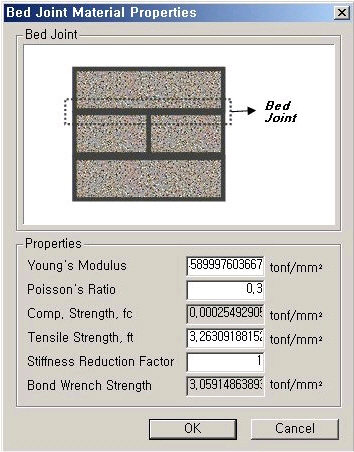
Bed Joint Material Properties
Young's Modulus
Poisson's Ratio
Comp. Strength, fc
Tensile Strength, ft
Stiffness Reduction Factor
Note
Stiffness reduction factor should be greater than "0". If the
stiffness reduction factor is "1", stiffness will not be reduced
and will remain elastic.
Bond Wrench
Strength
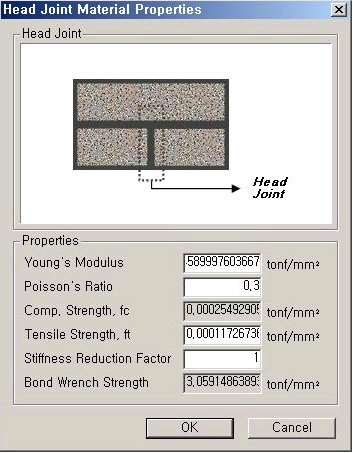
Head Joint Material Properties
Young's Modulus
Poisson's Ratio
Comp. Strength, fc
Tensile Strength, ft
Stiffness Reduction Factor
Note
Stiffness reduction factor should be greater than "0". If the
stiffness reduction factor is "1", stiffness will not be reduced
and will remain elastic.
 Revision of Gen 2010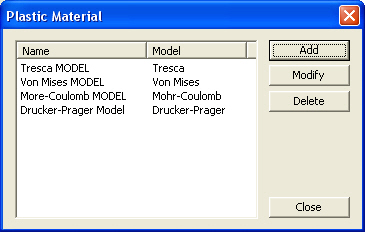
 For new
or additional material properties
For new
or additional material properties in the Plastic Material
dialog box and enter the following data:
in the Plastic Material
dialog box and enter the following data: Name:
Name: