Mohr-Coulomb
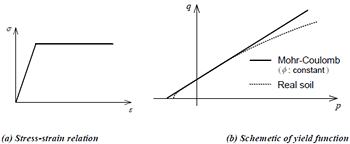
The Mohr-Coulomb model is generally used to model granular materials such as soil and concrete. The stress-strain relationship is considered as elasto-perfectly plastic. However, there are certain limitations to Mohr-Coulomb model, listed below:
1. The intermediate principal stress does not have any influence on the failure stress.
2. The straight failure envelope provides the soil the internal friction angle which is independent of the hydrostatic pressure.
3. Discontinuity of the yield surface at the corner may cause difficulties in a numerical analysis.
Applicable Modules:
Ground
|
Slope |
Soft Ground |
Foundation |
Seepage |
Dynamic |


General Parameters
Modulus of Elasticity (E)
The slope of the stress-strain line for a linear isotropic material.
Poisson's Ratio (u)
The ratio of the radial (or lateral) strain to the vertical strain.
Temperature Coeff. (α)
The relative change of a physical property when the temperature is changed by 1 K.
Unit Weight (Υt)
The weight of soil per unit volume.
Saturated Unit Weight (Υsat)
The weight of saturated soil per unit volume.
Cohesion (c)
It is a measure of the forces that cement particles of soil.
Internal Friction Angle (Φ)
It is a measure of the shear strength of soils due to friction.
Earth Pressure Coeff. (Ko)
The ratio of horizontal principal effective stress to the vertical principal effective stress.
Draining Condition
Drained
Dissipation of pore water pressure takes place upon the load application.
Undrained
Dissipation of pore water pressure does not take place upon the load application.
Skempton 'B' Coefficient
Enter the value of the coefficient for an 'Undrained' condition.
Hori. Permeability Coeff. (Kh) (only for Soft Ground Module)
The coefficient of permeability in horizontal direction.
Ver. Permeability Coeff. (Kv) (only for Soft Ground Module)
The coefficient of permeability in vertical direction.
Additional Parameters
Variation in Modulus of Elasticity
Change of elasticity modulus within a ground layer of identical parameters with change in depth referenced w.r.t. Reference Height. It is calculated on the basis of the Modulus of Elasticity defined under General Parameters.
Variation in Cohesion
Change of cohesion within a ground layer of identical parameters with change in depth referenced w.r.t. Reference Height. It is calculated on the basis of the Cohesion (c) defined under General Parameters.
Reference Height
Height taken as a reference (in GCS) for considering variation of parameters.
Dilatancy Angle (ψ)
It represents the ratio between a volumetric strain and a shear strain rate. If un-checked, the same value as the Internal Friction Angle is reflected in analysis.
Tensile Strength
Input when tension cut-off is considered. It is set to zero if a larger value is entered than the Cohesion (c) and the tensile strength calculated from the Internal Friction Angle (Φ) specified in General Parameters.
Safety Factor Calculation (only for Tunnel Module)

The safety factor is calculated on the basis of the ratio of the current state of stress of the material to the Mohr-Coulomb failure criterion. The Mohr-Coulomb failure criterion is most widely used criterion for brittle materials like ground. SoilWorks uses the criterion for all the material models in the Tunnel Module.