If
Load Control is selected, pushover analysis is carried out to reach the
estimated collapse load (Qud) through the load increments.
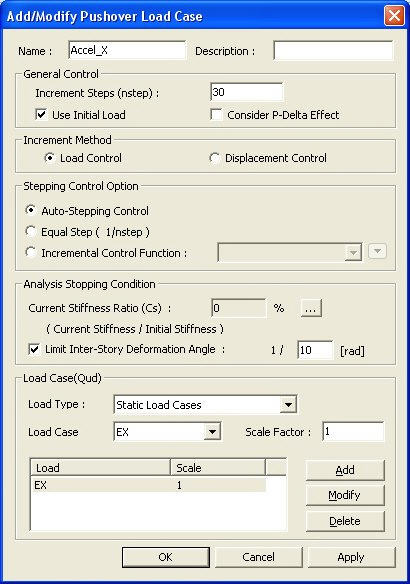
Pushover Load Case dialog box (Load Control)
Load Case Name
Enter the load case name
pertaining to Pushover analysis.
Description
State a brief description
related to the pushover load case.
General Control
Incremental Steps (nstep) : Number of steps to reach the estimated
collapse load
Note
The incremental steps must
be entered as a positive integer value (nstep¡Ã1), and minimum 20 steps
are recommended. (Default = 20)
Use Initial
Load : Check on to assign the load defined prior to Pushover analysis
as the initial load for Pushover analysis.
Note
When
P-M interaction is considered, the user needs to apply the initial load.
Consider P-Delta Effect :
Check on to consider P-Delta geometric nonlinear effects.
Note 1
P-Delta
effect is very important in pushover analysis. Lateral displacement caused
by the lateral load can be magnified by the gravitational load and this
effect can reduce the lateral stiffness of the structure. Especially when
plastic hinges occur at the lower part of the columns, which are under
large axial forces, the reduced lateral stiffness can cause the collapse
of the structure.
Note 2
Tthe
stiffness rapidly decreases after reaching peak strength in case of FEMA
and Eurocode type hinge, while geometric stiffness is neglected after
reaching ultimate strength, i.e. Collapse Prevention (CP) and Near Collapse
(NC), respectively.
Stepping Control Option
Specify the control data
for the load increment.
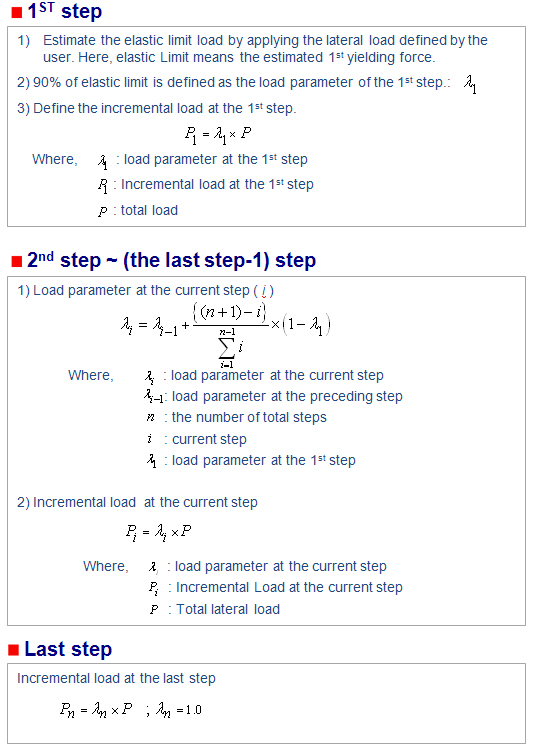
Auto-Stepping
Control : The applied load (Qud) is
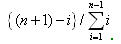
divided by the automatically calculated load parameters. The first step
is loaded up to 90% of the elastic limit of the structure. Further steps
are automatically divided by the ratio of.
Note 1
Elastic
limit means the estimated load under which the first yield occurs.
Equal
Step (1/n step) :The applied load (Qud) is equally divided by the
number of nstep.
Incremental
Control Function
: The applied load (Qud) is divided by the user-defined function. Refer
to Design>Pushover Analysis>Pushover Increment Functions
to see how to define user-defined function.
Analysis Stopping Condition
Specify
the condition of termination of Pushover analysis.
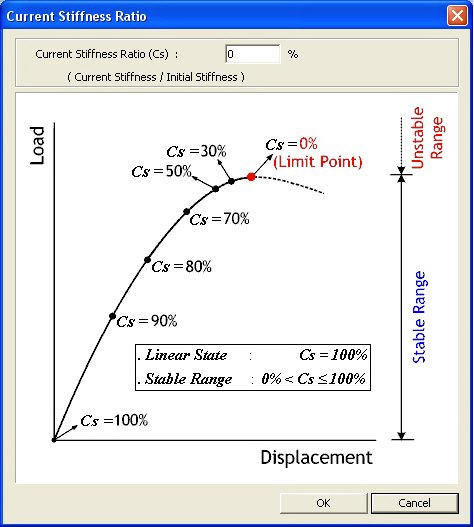
Current
Stiffness Ratio (Cs) : If the Current Stiffness Ratio (Cs) is entered
and the ratio of the stiffness at the current an incremental step to the
initial stiffness reaches the specified value, the analysis is terminated.
For example, if the user specifies the Current Stiffness Ratio as 5%,
analysis will be terminated when the ratio of the current stiffness to
the initial stiffness becomes 0.05.
Note
In addition to the above conditions for
termination of analysis, analysis is also terminated if the maximum number
of increments is reached, or negative values are encountered in the stiffness
matrix.
Limit
Inter-Story Deformation Angle
: If the Limit Inter-Story Deformation Angle is entered and the maximum
Inter-Story Deformation Angle reaches the specified value, the analysis
is terminated. (Default=1/10)
Load Case(Qud)
Define the type of load
pattern (ratio of magnitude) to be applied to pushover analysis
Load Type
Static
Load Case: Use the load pattern of static load cases that have
been defined.
Note
The combination of load cases multiplied by
the corresponding scale factors is used as the load pattern.
Uniform
Acceleration: The load is distributed relative to the inertia forces
developed in the structure, which has been subject to a uniform acceleration.
If the acceleration is uniform, the load pattern is determined proportionally
to the mass at each story level.
Mode
Shape: The pushover load pattern retains a mode shape and as such,
eigenvalue analysis is a prerequisite. The user can select the orders
of natural modes that are applied to determining the pushover load pattern.
Load
Case/Direction/Mode: Specify the load cases/directions/mode related
to the specified load type.
Note 1
For the Static Load Cases: All the static
load cases are activated.
For the Uniform Acceleration: Load distribution
directions (DX, DY, DZ) are activated.
For the
Mode Shape: The User directly enters the mode. For this option, eigenvalue
analysis must precede pushover analysis.
Note 2
If the following temperature loads are
entered in the Load Pattern input box, pushover analysis cannot be performed.
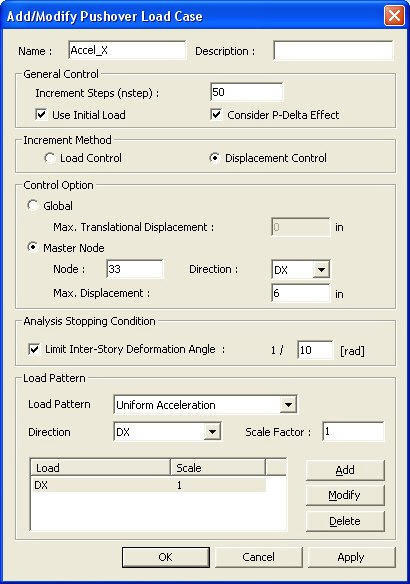
If Displacement
Control is selected, pushover analysis is carried out to reach the target
displacement through the incremental displacements.
Pushover Load Case dialog box (Displacement Control)
Load Case Name
Enter the load case name
pertaining to Pushover analysis.
Description
State a brief description
related to the pushover load case.
General Control
Specify the general control
data for nonlinear analysis.
Incremental
Steps (nstep) : Number of steps to reach the prescribed displacement
Note
The incremental steps must
be entered as a positive integer value (nstep¡Ã1), and minimum 20 steps
are recommended. (Default = 20)
Use
Initial Load : Check on to assign the load defined prior to Pushover
analysis as the initial load for Pushover analysis.
Note
When P-M
interaction is considered, the user needs to apply the initial load
Consider
P-Delta Effect : Check on to consider P-Delta geometric nonlinear
effects.
Note 1
P-Delta effect is very important
in pushover analysis. Lateral displacement caused by the lateral load
can be magnified by the gravitational load and this effect can reduce
the lateral stiffness of the structure. Especially when plastic hinges
occur at the lower part of the columns, which are under large axial forces,
the reduced lateral stiffness can cause the collapse of the structure.
Note 2
The
stiffness rapidly decreases after reaching peak strength in case of FEMA
and Eurocode type hinge, while geometric stiffness is neglected after
reaching ultimate strength, i.e. Collapse Prevention (CP) and Near Collapse
(NC), respectively.
Control Option
Specify the Target Displacement
to be applied to pushover analysis
Global Control
Target displacement is specified with
respect to the node where the maximum translational displacement occurs.
Maximum
Translational Displacement: Specify the max. target translational
displacement.
Note
For
any structure with an irregular plan the node and direction of maximum
displacement can be changed at each increment.
Master Node Control
Target displacement is specified relative
to the master node.
Master
Node: Master Node number
Master
Direction: Select one of the three translational directions for
the target displacement in the GCS.
Maximum
Displacement: Max. target displacement
Analysis Stopping Condition
Specify
the condition of termination of Pushover analysis.
Limit Inter-Story
Deformation Angle :
If the Limit Inter-Story Deformation Angle is entered and the maximum
Inter-Story Deformation Angle reaches the specified value, the analysis
is terminated. (Default=1/10)
Load Pattern
Define the type of load
pattern (ratio of magnitude) to be applied to pushover analysis
Load : In a
pushover analysis by displacement control, relative proportions are of
importance for the distribution pattern rather than the magnitudes of
the loads.
Static
Load Case : Use the load pattern of static load cases that have
been defined.
Note
The combination of load cases multiplied
by the corresponding scale factors is used as the load pattern.
Uniform
Acceleration : he load is distributed relative to the inertia forces
developed in the structure, which has been subject to a uniform acceleration.
If the acceleration is uniform, the load pattern is determined proportionally
to the mass at each story level.
Mode
Shape : The pushover load pattern retains a mode shape and as such,
eigenvalue analysis is a prerequisite. The user can select the orders
of natural modes that are applied to determining the pushover load pattern.
Load
Case/Direction/Mode : Specify the load cases/directions/mode related
to the specified load pattern
Note 1
For the Static Load Cases: All the static
load cases are activated.
For the Uniform Acceleration: Load distribution
directions (DX, DY, DZ) are activated.
For
the Mode Shape: The user directly enters the mode. For this option, eigenvalue
analysis must precede pushover analysis.
Note 2
If the following temperature loads are
entered in the Load Pattern input box, pushover analysis cannot be performed.