The
equivalent linear method on the FEA NX is applied to free
field analysis and 2D equivalent linear analysis. The
equivalent linear method approximates the ground material
nonlinearity as an equivalent linear material property
for linear iterative analysis. It is generally valid for
strain sizes of  . .
For
the equivalent linear method, the initial element shear
modulus G and initial damping ratio h need to be set for
each layer. Generally, the values when the strain is minimum
are used, and the frequency domain analysis is conducted
to calculate the maximum shear strain  of each layer or element. The effective shear strain
 is calculated as 0.65 or using the earthquake
magnitude is calculated as 0.65 or using the earthquake
magnitude by multiplying by multiplying  to that value
and the shear modulus G and damping ratio h are calculated
using the dynamic material function curve, created from
the effective shear strain of each
layer or element. This analytical process is repeated
until the G and values h converge, generally determined
by the relative error of 5% or less, then the analysis
is complete and the calculated results are output. to that value
and the shear modulus G and damping ratio h are calculated
using the dynamic material function curve, created from
the effective shear strain of each
layer or element. This analytical process is repeated
until the G and values h converge, generally determined
by the relative error of 5% or less, then the analysis
is complete and the calculated results are output.
Free
field analysis finds the ground response to an input earthquake
at the in-situ ground stage before structure construction.
Free field analysis is often used to for the determination
of design response spectrum using ground surface vibration
estimation, liquefaction assessment using dynamic stress-strain
computation and the determination of earthquake load that
causes instability of ground or structures.
2D
equivalent linear analysis not only provides analysis
for the ground, but also for soil-structure interaction.
To minimize the earthquake damage, the seismic design
for underground structures is performed, and the stability
examination needs to be done to the structure that considered
seismic safety. If the structure is built on a soft ground
layer such as clay or silt layers, the vibrations in the
bedrock due to earthquakes can be greatly amplified at
the surface and hence, the effects on the structure by
the soil-structure interaction due to earthquake vibrations
need to be assessed in detail. Because underground structure
are different from ground structures in that the structural
response to earthquakes is mostly controlled by the ground
displacement, the dynamic material properties of the ground
and modeling method determines the analysis results. The
figure below displays the general information on modeling
the actual analysis domain using the finite element method
(FEM) for soil-structure interaction analysis.
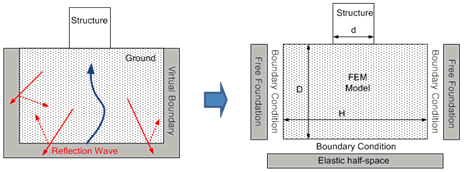
<Schematic diagram of analysis
domain and FEM modeling>
Boundary
conditions |
Analysis method |
Model depth |
Model
width |
Transfer |
Frequency domain |
- |
D ≥
2d |
Viscous |
Time
domain |
H ≥ d |
D ≥
5d |
Symmetric |
Effective stress |
|
D ≥
10d |
<Table. FEM model size to minimize
analysis result interference cause by the boundary>
The
main difference between soil-structure interaction problems
and normal structural dynamic problems is the radiation
damping effect due to the infinite property of the ground.
Normal damping properties come from material friction
etc. that dampens the structural movement, but radiation
damping radiates the wave energy into the infinite ground
space to dampen the structural energy. Hence, seismic
analysis conducted using the equivalent linear method
to consider the material nonlinearity and use the frequency
domain analysis, that makes the modeling of radiation
damping easier.

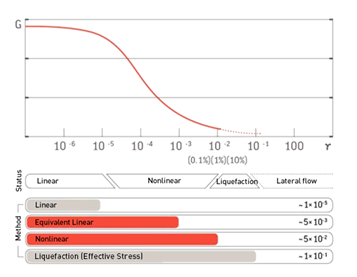
The analysis
method depending on the shear modulus G and shear
strain γ relationship is shown in the figure below.
|


