|
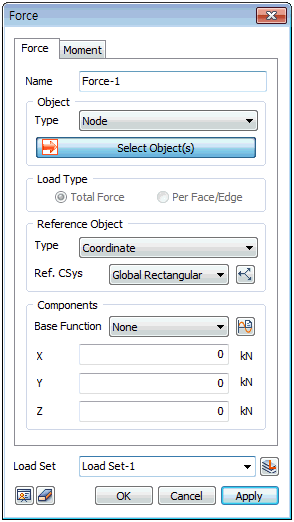
Select the node where the load will be applied and set the size and direction. The load direction can be set using Default Load or Reference Object Load methods. For Default Load, the x, y, z, components are input with reference to the coordinate system in the bottom right corner. For Reference Object Load, select the target and reference shape to set the load direction. If the reference shape is a line, the component direction is set in the line creation direction. If the reference shape is a surface, the normal direction to the surface becomes the z component direction and the left, right directions become the x, y component directions.
If the selected target shape is geometric, the Force can be selected as either a total force or individual loads in Load Type as shown below. For total force, the input load size is considered as the total force acting on the selected line/surface and is distributed evenly to all nodes. For individual loads, the input load size is applied to all nodes of the selected line/surface.
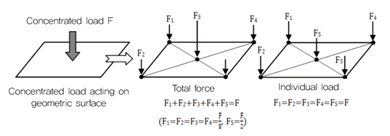
<Total force / Individual load processing>
The total force is distributed according to the length or area ratio when two or more targets are selected and the individual load is applied to each selected target.
[Object]
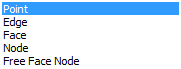
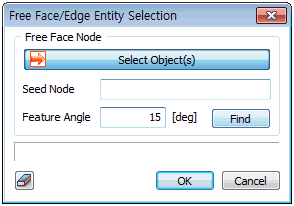
The applied load is defined on the node, but the selection target can also be set as a geometry shape (edge, surface etc.) or using auto-select free face nodes. For an edge or surface, the selected shape must have been used for element creation and the force is applied to all nodes in the specified direction/size. For free face nodes, select a free face node and all points that make contact with the node-containing element at an angle smaller than the specified angle (feature angle) will automatically be selected.
[Reference Object]
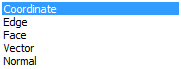
The load direction can be set using different methods. The reference coordinate system is the global rectangular(cylindrical) coordinate axis. Geometry shapes (edge and surface) can be selected as a reference direction. Selecting edge or surface displays the coordinate system of the selected shape and the load is set with reference to that system. The vector is used to specify the load direction using X,Y,Z vector components. The tangent direction can only be selected for surface objects and automatically sets the direction in the tangent direction of the selected surface.
[Components]
Input the load size according to the set direction. A positive (+) value applies the load in the set direction and a negative (-) value applies the load in the direction opposite of the set. The load size changes with respect to the coordinate value increase in the GCS can be defined using a reference function. Here, the input value is multiplied by the function value for application.
|


 Apply the Force or Moment load on an element node. Force is one of the most fundamental loads and it can be specified by 3 force components and a moment for each node. The direction can be defined with reference to an arbitrary coordinate system.