This
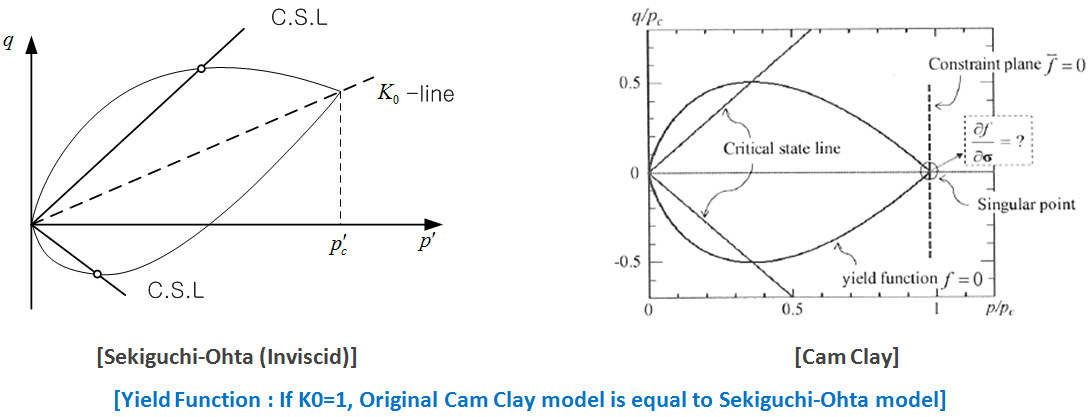
model is one of the Critical state theory model which
is similar to Modified Cam Clay model. The yield function
has K0 dependent terms, therefore users have to always
consider Ko condition (Earth pressure coefficient at rest)
for initial stress of ground (Ko Anisotropy is not applicable).
As the representative cohesive soil model, this can consider
the elasto-plastic behavior, but time-independent one.
[Nonlinear Parameters]
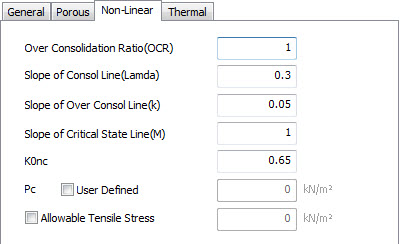
Following is the
summary of parameters for the Sekiguchi-Ohta(Inviscid)
model.
Parameter |
Description |
Reference value |
Nonlinear |
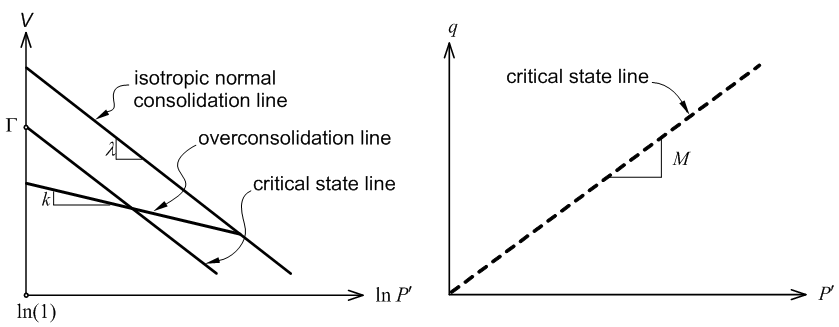
λ |
Slope
of normal consolidation line |
Cc
/ 2.303 |
κ |
Slope
of over-consolidation line |
Cs
/ 2.303
(Cc / 5 for a rough estimation) |
M |
Slope
of critical state line |
6
x sinФ’
/ (3-sinФ’)
(Ф’:
Effective internal friction angle) |
K0nc |
K0
for normal consolidation |
1-sinφ’
(< 1) |
Cap
yield surface |
OCR
/ Pc |
Over
Consolidation Ratio /
Pre-overburden
pressure |
When
entering both parameters,
Pc has the priority of usage |
Tallow |
Allowable
Tensile Stress |
*
Note |
[Allowable Tensile
Stress]
Fundamentally,
this model do not allow tensile stress in the failure
criteria (stress-strain relationship). However, various
conditions can generate tensile stress, such as the heaving
of neighboring ground due to embankment load during consolidation
or uplift due to excavation. To overcome the material
model limits and increase the applicability, analysis
on tensile stress within the 'allowable tensile stress'
range can be conducted.
The size of the allowable tensile
stress is not specified, and requires repeated analysis
to input a larger value than the tensile stress created
from the overburden load (embankment) or failure behavior.
However, when directly entering the pc (pre-consolidation
load), the allowable tensile stress cannot surpass the
pc value. When defining using the OCR, the pc value is
automatically calculated internally by considering the
size of the input allowable tensile stress.
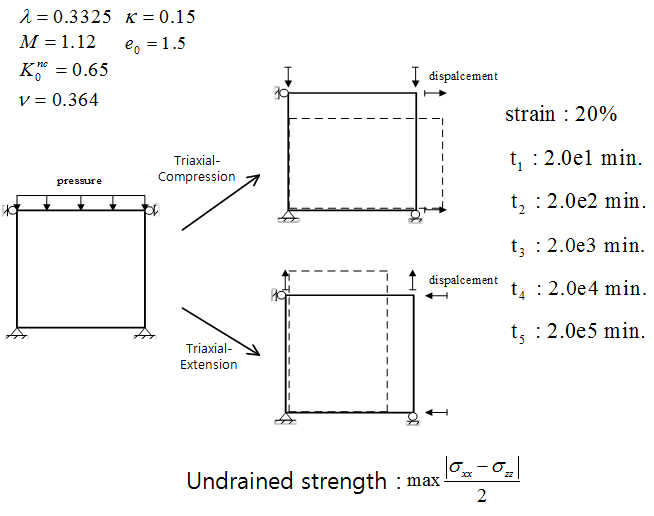
[Model Calibration]
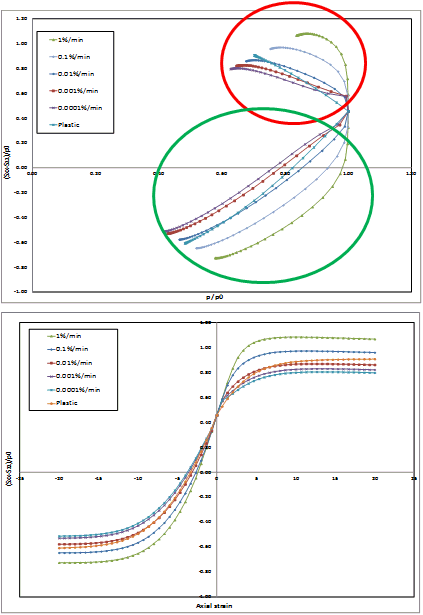
- Undrained Triaxial Compression and Extension test
- Effect of Strain Rate.
- Undrained
strength
depends on the rate
of shearing in
different
ways on
the compressional and extensional sides of shearing.
|


